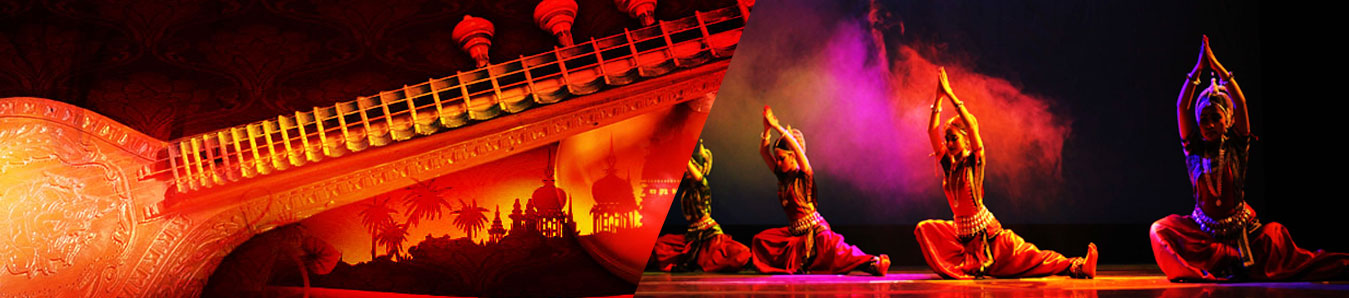
Culture, in India, although diverse and varied, still binds the country together in some form of common identification. Indian dance and music have played a remarkable role in this unification. India has a great heritage of classical dance and music. Using the body as a medium of communication, the expression of dance is perhaps the most intricate and developed, yet easily understood art form. Music too plays an important role in the Hindu religion. The tradition of Indian music should be understood in the context of Indian life and thought. It is known to be a mystical experience, analogous to yoga.
The classic Pakistani Qawwali music in its present form goes back to the 12th century, and the poet as well as composer Amir. But the qawwali music is perhaps even older. Qawwali, a sufi and religious music is closely connected to Islam. It is classic, but not in western meaning of the word. It is strictly built up in different stages. All with verse and chorus. The first stages activate the links with the living spiritual guides, the next with the departed saints and at last with God (Allah). It is believed that khayal form of music also originated from the qawwali style of singing.
The true rhythm of India lies in its folk music - the music of the masses. The extreme cultural diversity creates endless varieties of folk styles. Every event of life has a unique folk song associated with it - then be it festivals, advent of the new season, birth of a child, or day-to-day affairs like teasing one's loved one, admiring nature, etc. Music is an indispensable component of functions such as weddings, engagements, and births. There is a surfeit of songs for such occasions. The Indian folk music has today reached out to touch the hearts of masses across the globe with its melodious rhythm and endless energy.
Ghazal has its roots in classical Arabic poetry. Ghazal is an Arabic word which literally means talking to women. It grew from the Persian qasida, which verse form had come to Iran from Arabia around the 10th century A.D. The qasida was a eulogy written in praise of the emperor or his noblemen. The part of the qasida called tashbib got detached and developed in due course of time into the Ghazal. India has produced some of the exceptional talents in the field of ghazal singing like Begum Akhtar, Jagjit Singh, Pankaj Udhas etc.
The two fundamental elements of Hindustani classical music are raag and taal. Hindustani music is the music of North India, involving both Hindu and Muslim musicians. It is intimately associated with the north-Indian temple rituals and traces back its existence in the Shastras or ancient treaties in Sanskrit. The different forms of Hindustani music are - Dhrupad, Dhamar, Khayal, Tappa and Thumri.
Probably the most popular string instrument from India is the sitar. String instruments have gained popularity because strings are considered to be the best accompaniment to singing, a prime element of Indian music.
Sarod is another popular stringed instrument. The body is carved from a single piece of well-seasoned teakwood and the belly covered with goat skin. There are four main strings, six rhythm and drone strings and fifteen sympathetic strings, all made of metal. These are played by striking with a plectrum made of a coconut shell.
The name derives from Sau Rangi meaning 100 colours. It has three to four main playing strings and about a dozen sympathetic strings. The instrument has no frets orfingerboard; the strings float in the air.
Esraj is a combination between saringda and sitar. The base of the instrument is like saringda while the neck and strings are like sitar. It gives a sound very much like sarangi without being as difficult to play. It is quite popular in West Bengal.
It has four strings tuned to the tonic. The tanpura is known for its very rich sound. There are three main styles; the Miraj style, the Tanjore style and the small instrumental version sometimes called tamburi.
Santoor is a North Indian instrument originating from Kashmir. It has more than a hundred strings which run across a hollow rectangular box and the strings are struck by a pair of slim carved walnut mallets.
The Vichitra Veena is a stringed instrument like the rudra vina except it has no frets. It is played with a slide like a Hawaiian guitar.
Violin was introduced to India about 300 years ago and is a very important string instrument in the South of India. It is played in a sitting position and is held between the right foot and the left shoulder.
Tabla is a pair of drums. It consists of a small right hand drum called dayan and a larger metal one called bayan. The function of the black spots on each of the playing surfaces is to create the bell-like timbre that is characteristic of the instrument.
Pakhawaj is essentially a north Indian version of the mridangam and is the most common north Indian representative of the class of barrel shaped drums known as mridang. During the last few generations tabla has usurped its position of importance.
Bears a strong superficial resemblance to pakhawaj but there are major differences in construction and technique. It is the most used drum in South Indian music.
This instrument is a set of china bowls that are filled with water. Each bowl is struck with a light wooden mallet to cause it to ring. Jal tarang is not very common and is normally found in the accompaniment of Kathak dancers.
Very popular folk drum of northern India. It is barrel shaped with a simple membrane on the right hand side.
This is a long bodied drum with both ends covered in skin and plays an important role in Manipuri dancing when it is played by men and women, either in a sitting position or standing position.
Flute is found in every part of India, carved from bamboo it is made in every possible size.
A double reeded wind instrument with a widening tube towards the lower end. There are eight or nine holes, the upper seven for playing and the lower ones fortuning. The Shehnai is considered auspicious and is played on all festive occasions in India.
The Indian folk dance is simple without being naive, for behind its simplicity lie both profundity of conception and a directness of expression which are of great artistic value. The concept of portraying emotion is generally speaking foreign to folk dance and what is expressed is natural and original. What is important here is not the grace of the individual dancer or the virtuosity of the isolated prose, but the total effect of the overwhelming buoyancy of spirit, and the eloquent, effortless ease with which it is expressed. It has intimate relationship with functions of daily life; food-gathering, harvesting, rites, rituals and beliefs. The popular folk dances of India are Ruk Mar Nacha, Purulia Chhau, Rangoli Bihu, Singhi Chham, Karma, Cheraw Dance, Hojagiri, Bardo Chham, Chang Lo, Lahoo and Thang Ta in the East. Bhangra, Charkula, Ghoomar, Spaw Dance and Kinnauri Nati in the North. Kalbelia Dance, Koli, Tarangmel, Dandiya Raas, Garba, Tippani Dance, Panthi, The Padhar Dance, Dharmar and Hamchi Dances in the West. Devarattam, Dollu Kunita, Thapetta Gullu, Garadi, Lava Dance and Nicobarese Dance in the South.
Bharata Natyam, originating in Tamil Nadu, has movements of pure rhythm, rendering a story dramatically in different moods. For a long time, Bharat Natyam was performed only in temples by dancers in service of the temple, the devadasis. The dancers must learn the language of gestures, mudras - so as to express feelings, movements and characters in the stories which she narrates through dance.
The Kathak dance form originated in the north. The influence of the Mughal tradition is evident in this dance form, and it has a distinct Hindu-Muslim texture. The word Kathak, derived from 'Katha', literally means storyteller. Today, the maestros of this dance form include Birju Maharaj and Uma Sharma. Kathak has an exciting and entertaining quality with intricate footwork and rapid pirouettes being the dominant and most endearing features of this style. The costumes and themes of these dances are often similar to those in Mughal miniature paintings.
Kathakali, a well-developed dance-drama of Kerala is a performance where the actors depict characters from the epics Ramayana and Mahabharata and from the Puranas (ancient scriptures). The dancers adorn themselves in huge skirts and headdress, wearing a most intricate style of make-up. Kathakali draws heavily from drama and is danced with elaborate masks and costumes. Like Bharatanatyam Kathakali also needed a resurrection in the 1930s. The great poet Vallathol rediscovered Kathakali, establishing the Kerala Kalamandalam in 1932 which lent a new dimension to the art-form in South India.
Protected for years in a valley of exceeding beauty, Manipuri is the art expression of every man, woman and child of Manipur. The musical forms of that culture reflect the worship of Vishnu. It is around episodes from his life that the faith of the people is entwined. The sanskirtan and the rass are revered musical traditions enacted appropriately at different times of the year by the community as a whole. Manipuri is not aggressive. It is tender and almost reticent on the one hand, and extremely vigorous on the other. A continuity of movement and a restraint of power are underlying features of the style.
This dance form is believed to have been introduced to Kerala by the early Aryan immigrants & is performed only by the members of the Chkiar caste. A highly orthodox type of entertainment, it can be staged inside temples only & witnessed by the Hindus of the higher castes. The theatre is known as Koothambalam. The story is recited in a quasi-dramatic style with emphasis on eloquent declarations with appropriately suggestive facial expressions & hand gestures. The only accompaniments are the cymbals & the drum known as the mizhavu, made of copper with a narrow mouth on which is stretched a piece of parchment.
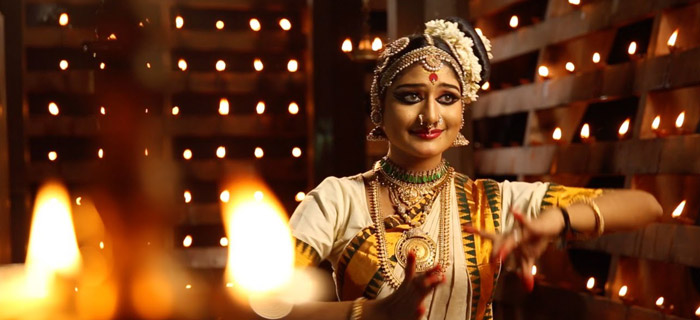
Mohiniyattam, the female semi-classical dance form of Kerala is said to be older than Kathakali. Literally, the dance of the enchantress, Mohiniyattam was mainly performed in the temple precincts of Kerala. It is also the heir to Devadasi dance heritage like Bharata Natyam, Kuchipudi and Odissi. The word 'Mohini' means a maiden who exerts desire or steals the heart of the onlooker. There is a well known story of Lord Vishnu taking on the guise of a 'Mohini' to enthrall people, both in connection with the churning of the milk ocean and with the episode of slaying of Bhasmasura. Thus it is thought that Vaishnava devotees gave the name of Mohiniyattam to this dance form.
The ambience of Orissa, the philosophy of Lord Jagannath and the sculpture of the 13th - century Sun Temple of Konarak, are reflected in its dance form – Odissi. Perhaps the most lyrical style of dance in India, Odissi follows unique body norms; the iconography of a whole culture is echoed in its structure. The tribhanga, a three-bend posture, interlinking a people’s philosophy with the physical, is a series of triangles which are not only physically difficult to execute, but which also call for immense restraint and finesse on the part of the artist. The numerous postures of the style reflect specific moods and adorn the carved panels of the Konark Sun Temple.
The Chhau dance is indigenous to the eastern part of India. It originated as a martial art and contains vigorous movements and leaps. Some Chhau dances use large stylized masks. The depiction of birds and animals is a distinctive feature. There are also heroic dances with sword, bow or shield, with which dancers demonstrate their dexterity. In recent times, Mayurbhanj Chhau has become popular as a medium of choreography, with its wide range of postures and movements that adapt well to modern as well as traditional treatment.
Design your tour with our expertise Plan My Trip