|
|
|
Madhya
Pradesh |
| |
 |
At the heart of India, the magic of Madhya Pradesh lies
in its exquisitely carved temples, proud fortresses and
variety of wildlife. Most of the state is a high plateau,
historically known as the Malwa region. Bhopal, the capital
of Madhya Pradesh, is a fascinating amalgam of an old
historic city, and modern urban planning.
The history of Madhya Pradesh goes back to the time of
Ashoka, the great Mauryan ruler. To the Chandelas, however,
goes the credit of building the fantastic monuments of
Eros, Khajuraho, in the north of the state.
|
| The state's
cultural lineage is ancient and checkered. Madhya Pradesh
occupies a special position in the history of music. The
Gwalior gharana is among the most prominent arbiters of
style. The rivalry of Tansen and Baiju Bawra is remembered
in fantastic detail to this day. |
| |
| |
| Bhopal |
The history of Bhopal dates back to the 11th century AD,
when it was built by the legendary King Bhoja. The decline
of the Mughal Empire with the death of Aurangzeb (AD 1707)
led to political turmoil in this region. It was the second
largest Muslim state during the rise of British power
in India.
Bhopal is the capital city of the state of Madhya Pradesh,
which is the largest state in India. The city is also
referred to as the City of Lakes because of the two beautiful
lakes that are situated in the center of the city. |
| Bharat Bhavan is a showcase
of Indian art, folk traditions, sculpture and a centre
for the performing arts as well. Bhimbetka, a few hours’
drive from Bhopal, is the site for spectacular cave paintings;
Udaygiri, another excursion from Bhopal, has notable cave
sculptures of religious themes. |
Altitude: 572
meters, Climate: (deg C)-Summer- Max 47.7, Min
24.9; Winter- Max 24.5, Min 9.1, Best Season: October
to March. |
Places Of Interest:
Taj-ul-Masjid , Juma Masjid , Moti Masjid, Shaukat Mahal
, Bharat Bhawan and Roopankar, Shamla and Idgah Hills.
Chowk, Upper and Lower Lake , Gandhi Bhavan, Van Vihar. |
Excursions:
Bhimbetka- 40 kms, Bhojpur- 28 kms, Chiklod- 45 kms, Dhelwadi-
62 kms, Islamnagar-11 kms, Neori- 6 kms, Raisen- 47 kms,
Sanchi- 46 kms, Vidisha- 56 kms, Ginnorgarh Fort- 61 kms. |
Reach -
By Air: Well connected with all major towns.
By Rail: Bhopal is well connected with all major
cities. By Road: Bombay- 789 kms, Aurangabad-
588 kms, Ahmedabad- 571 kms, Agra- 523 kms, Delhi- 728
kms, Gwalior- 422 kms, Gwalior- 422 kms, Indore-187 kms,
Ujjain- 189 kms, Sanchi- 46 kms, Khajuraho- 387 kms, Mandu-
290 kms, Pachmarhi- 210 kms. |
 |
|
|
| |
|
| |
|
| Sanchi |
Sanchi is famous for its stupas, monasteries, temples
and pillars dating from the 3rd century BC to the 12th
century AD. The Sanchi Stupa, the best known of all, was
originally built by the Mauryan Emperor Ashoka, then Governor
of Ujjayini, whose wife Devi was the daughter of a merchant
from the adjacent Vidisha. Sanchi has the singular distinction
of having specimens of almost all kinds of Buddhist architectural
forms, stupas, chaityas, temples and monasteries - the
finest examples of Buddhist creative art and sculpture
in the country. |
 |
Altitude: 427
meters, Climate: (deg C)-Summer- Max 45, Min 25;
Winter- Max 22.5, Min 10, Best season: October
to March. |
Places Of Interest:
Great Stupa No.1, Toranas or Gateways, Stupa No. 2, Stupa
no. 3, Ashoka Pillar, Buddhist Vihara, Monasteries. |
Excursions:
Andhara and Pipalilya- 17.7 and 12 kms, Besnagar- 12 kms,
Gyaraspur- 41 kms, Raisen Fort- 23 kms, Sonari and Satdhara-10
kms, Udaigiri- 13 kms. |
Reach -
By Air: Nearest airport is Bhopal- 46 kms.
By Rail: Nearest railhead is Bhopal 46kms.
By Road: Bhopal- 46 kms, Vidisha- 10 kms, Indore-
232 kms etc. |
|
|
| |
|
| |
|
 |
| Gwalior |
 |
According to a legend, Gwalior derives its name from a
great sage Gwalipa who cured a chief of the Kachwaha clan
suffering from leprosy. Gwalior’s strategic position between
north and south India made it an important possession
and was captured by several ruling houses. The first historical
holders of the city were the Huns. Held in succession
by the Mughals, Jats, Marathas and the British, Gwalior
was finally handed over to Jiyaji Rao Scindia at a formal
durbar in 1885. |
| The Scindias were the last
ruling family of Gwalior and are still influential in
the political arena of India. It is also sacred to the
memory of the heroic queen Rani of Jhansi and Tatya Tope. |
Area: 82 sq.
km, Altitude: 212 meters, Climate: (deg
C) – summer 46 Deg. 21 Deg. Winter: 22 Deg. 6 Deg, Best
Season: October to March. |
Places Of Interest:
The Cenotraphs, Man Singh Palace, Man Mandir Palace, Gujari
Mahal, Suraj Kund, Teli ka Mandir, Sas Bahu ka Mandir,
Rani Jhansi Memorial, Tombs of Tansen and Ghaus Mohammad,
Jai Vilas Palace, Gandhi Park, Zoo Municipal Corporation
Museum, Jivaji Rao Scindia Museum. |
Excursions:
Tigra's Dam- 23 kms, Pawaya- 68 kms, Datia- 68 kms, Orchha-
120 kms, Shivpuri- 112 kms, Chanderi- 209 kms, Narwar–
128kms, Narwar Fort. |
Reach -
By Air: Well linked all with major towns. By
Rail: Gwalior is connected to all major cities in
India. By Road: Agra- 118 kms, Bhopal- 420
kms, Delhi- 318 kms, Khajuraho- 280 kms, Sanchi- 344 kms,
Shivpuri- 112 kms, Indore- 486 kms, Bombay-1086 kms. |
 |
|
|
| |
|
| |
|
| Orchha |
The medieval city of Orchha, in the state of Madhya Pradesh,
seems to have frozen in time, its palaces and temples
still retaining their original grandeur. Orchha had the
distribution of being the capital of one of the largest
and most powerful kingdoms of Central India. The Bundela
Rajput chieftain, Rudra Pratap, founded the city, located
by the side of the beautiful Betwa River, in the 16th
century.
The word Orchha means 'hidden'. When the Tughlaqs, who
were ruling Delhi in the 15th century, pushed the Bundelkhand
rajas out of Garkhundar, they retreated to distant Orchha. |
Places Of Interest:
Jehangir Mahal, Raj Mahal, Raj Praveen Mahal, Ram Raja
Temple, Chaturbhuj Temple, Laxmi Narayan Temple, Phool
Bagh, Dinman Hardaul's Palace, Sunder Mahal, Cenotraphs,
Shahid Smarak. |
Reach -
By Air: Nearest airport is Gwalior -120 kms.
By Rail: Nearest railhead is Jhansi -19 kms.
By Road: Orchha lies on the Jhansi - Khajuraho
road. |
 |
|
|
| |
|
| |
|
| Khajuraho |
 |
The fascinating temples of Khajuraho, India's unique gift
of love to the world, in the state of Madhya Pradesh,
were built between 950 and 1050 A.D. Khajuraho derives
its name from the Khajur tree (the date palm tree) which
can be found in abundance in the area. The divine sculptures
in these temples are a tribute to Life itself, embodying
everything that is sublime and spontaneous about it.
With the wane of the Chandela Empire, these magnificent
temples lay neglected, and vulnerable to the ravages of
Nature. It was only in this century, that they were rediscovered,
restored and granted the recognition that they justly
deserve. |
Originally there were 85 temples, of which only 22 still
exist. These magnificent temples dedicated to Lord Shiva,
Lord Vishnu and the Jain Tirthankaras. The three main
compartments are the entrance (ardhamandapa), assembly
hall (mandapa), and the actual sanctum (garbha griha).
The temples are grouped into three geographical divisions:
western, eastern and southern. |
Climate: (deg
C) -Summer 47 Deg. C. 21 Deg. C, Winter 32 Deg. C. 4 Deg.
C, Rainfall: 114 cm. (July-September), Best
Season: October to March. |
Excursions:
Dhubela Museum- 64 kms, Beni Sagar- 11 kms, Panna Diamond
Mines- 56 kms, Panna National Park- 60 kms, Pandav Falls-
35 kms, Raigarh Palace- 25 kms, Raneh Falls- 20 kms, Ranguan
Lake- 25 kms, Ajaygarh Fort- 80 kms, Kalingar Fort- 125
kms, Nachana- 100 kms. |
Places Of Interest:
The temples of Khajuraho are divided into three geographical
groups viz, Western, Eastern, and Southern groups. |
Western Group of
Temples:
Chausath Yogini Temple, Kandariya Mahadeo Temple, Devi
Jagdamba Temple, Chitragupta Temple,Vishwanath Temple,
Parvati Temple, Lakshmana Temple, Matangeshwara Temple. |
Eastern Group of
Temples:
Brahma Temple, Vamana Temple, Parsvanath Temple, Ghantai
Temple. |
Southern Group
of Temples:
Dulhadeo Temple, Chaturbhuj Temple, Archaeological Museum. |
Reach -
By Air: Well connected with Delhi. By Rail:
Jhansi-175 kms, Satna-117 kms, Harpalpur-110 kms.
By Road: Agra- 395 kms, Allahabad- 285 kms, Bandhavgarh-
237 kms, Bhopal- 372 kms Chitrakoot- 176 kms, Delhi- 590
kms, Jabalpur- 296 kms Lucknow- 267 kms, Varanasi- 415
kms. |
 |
|
|
| |
|
| |
|
| Indore |
Planned and built by Rani Ahilyabai, the brave Holkar
queen, Indore lies to the extreme west of Madhya Pradesh
on the banks of the rivers Saraswati and Khan which unite
at the centre of the city. Indore derives its name from
the 18th century Indreshwar Temple.
The history of Indore is inseparable from the history
of the Holkar State. The founder of the House of Holkars
was Malhar Rao Holkar, born in 1693 AD. Ahilya Bai was
one of the foremost Maratha personalities and an extraordinary
woman ruler of India. She was the rare Indian royalty
who was deified in her lifetime. |
| Though Ahilya Bai loved
Indore immensely, it was only after her death that the
State capital was shifted from Maheshwar to Indore in
1811 AD. Today, her statue adorns the centre of the city,
Rajwada. |
Climate: (deg
C) - Summer Max- 40.5, Min- 27; Winter Max- 30.4, Min-
15, Rainfall: 110 cms (July to September), Best
Season: September to March. |
Places Of Interest:
Chhatri Bagh, Gita Bhavan, Lalbaug Palace, Bada Ganapati,
Juna Rajwada, Kanchi Mandir or Hukumchands Temple, Annapurna
Temple, Kendriya Sangrahalaya. |
Excursions:
Bagh Caves-153 kms, Ujjain- 53 kms, Mandu- 99 kms, Maheshwar-
90 kms, Omkareshwar- 77 kms. |
Reach -
By Air: Indore is well linked all major cities.
By Rail: Indore is well connected to major cities
of India. By Road: Agra- 605 kms, Ahmedabad-
456 kms, Bhopal- 187 kms, Bombay- 602 kms, Delhi- 809
kms, Gwalior- 486 kms, Khajuraho- 574 kms, Maheshwar-
90 kms, Mandu-105 kms, Ujjain- 53 kms. |
|
|
| |
|
| |
|
 |
| Ujjain |
 |
Ujjain, one of the venues of the Kumbh Mela. This mela
celebrates the saving of the earth by Lord Shiva and the
churning of the ocean by the Gods and The Demons to retrieve
the Kumbh (The pot of Amrit, the nectar of immortality).
Emperor Ashoka spent his years of tutelage as the viceroy
of Pataliputra here in Ujjain. Under the Guptas and the
Paramara kings, Ujjain was a centre of trade and scholarship.
The Vikramaditya University founded by the scholarly King
Vikramaditya also used Ujjain as its base. One of the
oldest and holiest of Indian cities, Ujjain is situated
on the banks of river Shipra. |
Altitude: 492
meters, Climate: (deg C)- Summer- Max. 40, Min.
20; Winter- Max. 28, Min. 10, Rainfall: 101 cms
(July to September), Best Season: September to
March. |
Places Of Interest:
Bharatahari Cave, Gopal Mandir, Jantar Mantar, Kailadah
Palace, Mahakali Temple, Sandipani Ashram, Shipra Ghats,
Vikram University Museum. |
Excursions:
Agar- 66 kms, Devas- 37 kms, Maksi- 39 kms, Nagada- 60
kms. |
Reach -
By Air: Nearest Airport is Indore-53 kms. By
Rail: Ujjain is well connected to all major towns.
By Road: Ahmedabad- 402 kms, Bhopal-183 kms, Bombay-
655 kms, Delhi- 774 kms, Gwalior- 451 kms, Indore- 53
kms and Khajuraho- 570 kms. |
 |
|
|
| |
|
| |
|
| Kanha
National Park |
Kanha National Park in the Mandla District spreads over
1,945 sq.km of dense sal forests, interspersed with extensive
meadows and trees and clumps of wild bamboo Situated in
the Indian state of Madhya Pradesh, the picturesque Kanha
National Park was the inspiration behind Rudyard Kipling's
unforgettable classic Jungle Book. By far the most striking
features of this region are the open grassy meadows, where
sighting blackbuck, swamp deer, sambhar and chital is
common. And, if one can transcend into time, a barefooted
Mowgli would perhaps come padding along the dusty trail,
for this is the land of Kipling's Jungle Book. |
 |
| If one were to point to
the middle of India, chances are he will pick out the
forests of the Banjar and the Halon valley, the two forming
the western and eastern halves of the Kanha Tiger Reserve,
which have long been famous for their wide diversity of
wildlife. |
Area: 1,945
sq.kms, Altitude: 600-900 meters. Climate:
(deg C)-Summer- Max 40.6, Min 23.9; Winter- Max 23.9,
Min 1.1. Rainfall: 152 cms, Best Season:
April to June and November to January. (The park is closed
from July to Mid November during monsoon) |
Wildlife in the
park:
The main attractions are Tiger, Bison, Gaur, Sambar, Chital,
Barasingha, Barking Deer, Black Deer, Black Buck, Chousihgha,
Nilgai, Mouse Deer, Sloth Bear, Jackal Fox, Porcupine,
Hyaena, Jungle Cat, Python, Pea fowl, Hare, Monkey, Mongoose,
Tiger, Leapord etc. can also be seen here. |
Birds species in
the park:
Storks, Teals, Pintails, Pond Herons, Egrets, Peacock,
Pea Fowl, Jungle Fowl, Spur Fowl, Patridges, Quails, Ring
Doves, Spotted Parakeets, Green Pigeons, Rock Pigeons,
Cuckoos, Papihas, Rollers, Bee Eater, Hoopes, Drongos,
Warblers, King Fishers, Wood Peckers, Finches, Orioles,
Owls, Fly Catchers. |
Reach -
By Air: Nagpur- 266 kms is the nearest airport.
By Rail: Jabalpur-169 kms is the nearest rail.
By Road: Jabalpur- 175 kms, Khajuraho- 445 kms,
Nagpur- 266 kms, Mukki -25 kms, Raipur- 219 kms. |
|
|
| |
|
| |
|
 |
| Bandhavgarh
National Park |
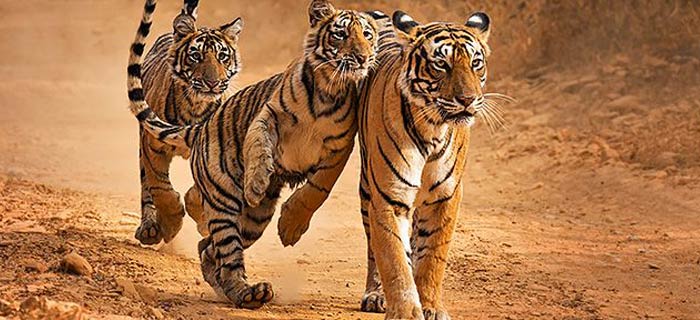
Set amongst the Vindhyas, in Madhya Pradesh, Bandhavgarh
is a small national park, but with the highest known density
of tiger population in India. This is also known as White
Tiger territory. These have been found in the old state
of Rewa for many years. Besides its enchanting landscape
formed by the Sal forest in the valleys and majestic tree
clad hills in the back-drop.
The Park is spread over an area of 437 sq. km.The terrain
is made of rocky hills, sal forests and grazing areas,
formerly agricultural land. |
The finest of these hills
is the Bandhavgarh hill, and on its highest point stands
Bandhavgarh Fort.
Several dynasties have ruled the fort: for example, the
Maghas from the 1st century A.D, the Vakatakas from the
3rd century; the Sengars from the 5th century, and the
Kalachuris from the 10th century.The oldest signs of habitation,
are the caves dug into the sandstone, near the fort. Several
of these contain Brahmi inscriptions dating from the 1st
century B.C. |
Area: 280 sq.
kms, Altitude: 400 to 810 meters, Climate:
(deg C)-Summer- Max 41.4, Min 26; Winter- Max 21.1, Min
9.6, Rainfall: 1174 mms, Best Season: March
to June. The park is closed from July to Mid-November. |
Wildlife in the
park:
Tiger, Leopard, Bear, Bison, Chital, Sambhar, Nilgai,Chinkara,
Chowsingha,Barking deer, Wild Pig, Hyaena, Porcupine. |
Birds species in
the park:
Peacock, Paradise fly catchers, Jungle Fowl, Golden and
Black headed Orioles, Yellow Ioras, Red-vented Bulbuls,
Blue Jays, Purple Sunbirds, Green Barbets and Mynahs. |
Reach -
By Air: Khajurao- 230 kms is the most nearest airport.
By Rail: The nearest railhead Umaria- 30 kms and
Satna- 117 kms. By Road: Khajuraho- 230 kms,
Varanasi- 340 kms, Katni- 75 kms, Rewa- 115 kms, Umaria-
30 kms, Kanha- 250 kms.
How to plan your tours
We are pioneer travel agents and tour operators of Khajuraho
– Madhya Pradesh -India… offers most ideal tours itineraries
to explore Indian tourism destinations. Visit at our itineraries
http://www.india-tourism.com/itineraries.htm
to chalk out your tour plan or you may write us… your
choice of destinations to design a tour for you with travel
period and budget to: sales@india-tourism.net
|
|
|
| |
|
| |
|
|
|
|
| |
|
|
<Top> |
|
|
|
| |
|
|
Mail
your queries at: sales@india-tourism.net |
|
|
|
|
Home |
About Us |
Our Services |
Testimonials |
Hotel Booking |
Car Rental |
Distance Calculator |
Currency Converter |
Contact us |
Site Map |
|
Explore India tourist destinations, we provide North and Central India vacations and trip, Madhya Pradesh tour operator and travel agent offers Madhya Pradesh travel Itineraries, holiday packages, Madhya Pradesh tour, tourism in Madhya Pradesh, Madhya Pradesh online travel guide, hotel in MP, vacations in Madhya Pradesh, official website, cultural tourism in MP, tailormade tour itineraries hotel approved by tourism of ministry of tourism, government of india, wildlife tours of madhya pradesh, central India tours, Kanha national park, Madhya Pradesh wildlife tourism, bandhavgarh national park, MP wildlife, Madhya Pradesh trip, Eastern India vacation, Indian tourism, national park, jungle safari, forest destinations, MP hotels, MP tourist attraction, Madhya Pradesh travel destination, trip adviser, vacations in Madhya Pradesh, places of interest in Madhya Pradesh, Mumbai based travel agent and tour operators, beaches tour, beaches holiday packages, Western India budget and luxury holiday packages, Northern India tourism, Southern India trip, Madhya Pradesh hotel bookings, reservation, car rental services in MP, planning, consultancy, Madhya Pradesh Holidays packages, tribal holiday, adventure and Wildlife tours, car hire, budget and luxury hotel accommodation, Madhya Pradesh tourist guide lines, ujjain spiritual city, travel destinations in MP, Khajuraho, Kanha, Mandu, pachmarhi, Bhopal, Sanchi, pradesh heritage tours, Madhya Pradesh tribal tours, Pachmarhi in Vindhya mountains, Pachmarhi hill station, marbel rocks of jabalpur, Mandu travel guide, Madhya Pradesh buddha monks, Sanchi stupa, Madhya Pradesh stupa, grand stupa, gateways, ashoka lions in Sanchi, ashokan pillarat Sanchi, kiran, 14th july 08, Madhya Pradesh holidays
|
|
| Copyrights
© Meruka India Tourism Service 2006. All Rights Reserved.
|
|
| Website Designed & Maintained By: India Tourism Net |
|
|
|