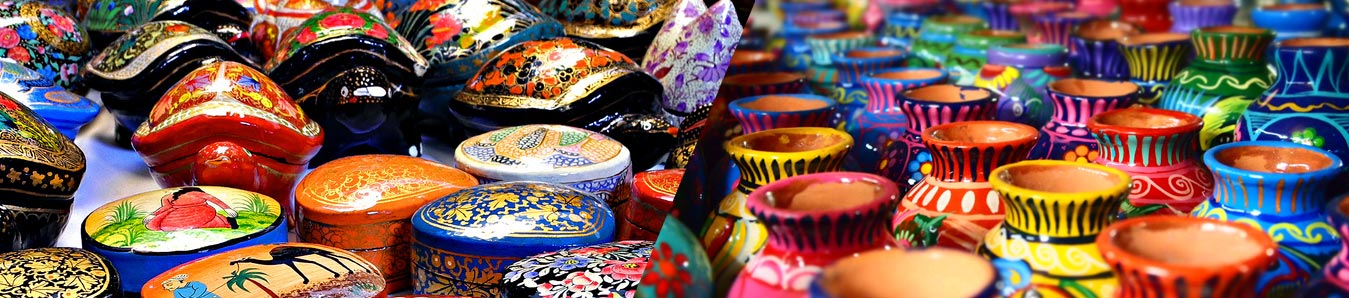
The story of Indian Arts & Handicrafts comes from one the oldest civilizations of the world. The vast cultural and ethnic diversity has enabled a variety of motifs, techniques and crafts to flourish on this land. Born of centuries old craftsmanship, the history varies designs and motifs that have fascinated the people the world over. Unique in their style reflects the mood in Indian heritage. The arts & craft of India are seen on the following headings.
Kashmir is the only state in India, where walnut trees grow. The craftsmen here create intricate carvings on wood obtained from the walnut tree. Furniture items like tables, chairs, stools, partitions etc have rich floral and trellis patterns carved on them. Carving done on walnut is either deep or shallow. Items like tables, fruit trays and bowls etc are also decorated with inlay work. Wax polishing is done on finished products, so that the beauty of the wood grain is not lost. Rajasthan is known for articles and decorative objects made from locally obtained wood.
Each region of Rajasthan has its own unique wood tradition. Barmer is well known for carved furniture. Some furniture pieces like tables, low stools etc have miniature paintings on them. Carved wood items such as cabinets, screens, chairs, tables, almirahs, racks etc are highly ornate. Rajasthan is also known for wood figurines in the shape of animals, which are beautified with inlay work. Exquisite jali or latticework is also produced here. Craftsmen of Rajasthan also make delicately carved figures of deities on rosewood and sandalwood. Craftsmen from Madhya Pradesh use a variety of wood like shisham, teak, dhudi, sal and kikar for making household items. Woodcraft from the tribal belt of Bastar is known for figures of tribal deities, carved wooden memorials, masks etc. Madhya Pradesh is also famous for painted and lacquered wood product such as toys, boxes, bedposts, cradles posts, flower vases etc. Gwalior, Sheopur-Kalan, Rewa and Budhni are main centers of wood lacquering. Uttar Pradesh has many craft centers engaged in making different items out of wood. Saharanpur is known for vine-leaf patterns on Sheesham wood. Floral, geometric and figurative carving is also done here with wood inlay work. Inlay work is done with bone and plastic as ivory is banned in India. Mainpuri is famous for woodwork on ebony or black sheesham inlaid with brass wire. Banaras is known for lacquered toys and miniature utensils for children to play with.
In early India, people fashioned jewellery out of natural materials found in abundance all over the country-seeds, feathers, leaves, berries, fruits, flowers, animal bones, claws and teeth. Even today such jewellery is used by the different tribal societies. Excavations at Mohenjodaro and other sites of the Indus Valley civilization have unearthed a wealth of ornaments. It appears that both men and women of that time wore jewellery made of gold, silver, copper, ivory and precious and semi-precious stones. The Ramayana and the Mahabharata are abound with descriptions of ornaments and the code of Manu defines the duties of the goldsmith. By the third century B.C., India was Gems & Jewelry the leading exporter of gemstones, particularly diamonds. Gold was usually imported into the country, a practice prevalent even during the Mughal period. In India the ornaments are made practically for every part of the body. Such a variety of ornaments bears the testimony to the excellent skills of the jewelers in India. The range of jewellery in India varied from religious one to purely aesthetic one. Jewellery was crafted not just for humans but also for the gods, ceremonial elephants and horses. The craft of jewellery was given a royal patronage right from the ancient times. The rajas and maharajas vied with each other to possess the most exquisite and the most magnificent pieces of jewellery. Temple complexes supported many different styles of jewellery-scented sandalwood bead necklaces, the prayer bead or the rudraksh (berry of the elaocarpus canitrus) necklace, multicoloured silk and gold thread necklaces. In the Hindu, Jain and Sikh community where women do not inherit landed property, jewellery was a major component of the stree dhana (gifts given to a woman at the time of her marriage). Jewellery, because of its easy convertibility into cash, was thus regarded as security and investment.
Indians knew the art of painting since prehistoric times. The earliest paintings in India can be found on the walls of Bhimbetka caves in Madhya Pradesh. The walls of these caves have been decorated with animal and human figures. The Indian art of painting is varied and diverse, like the cultures, to which they belong. Paintings are made using a variety of medium. Traditional Indian paintings depict gods and goddesses, mythological scenes, scenes pertaining to erstwhile royal houses and scenes from daily life.
Paintings created by artists belonging to different tribal societies are vibrant, symbolic and depict all aspects of tribal life. The introduction of Persian styled miniatures by the Mughals, lent a new dimension to the art of painting in India.
Not only were Mughal miniatures great masterpieces, they also influenced local miniature schools in Rajasthan, Punjab and Himachal Pradesh. Various miniature schools flourished in Rajasthan, during the Mughal era and continued even after it. Some of the important miniature schools of that period were: Mewar, Marwar, Kishangarh, Dhunbar and Hadoti school. Each school had its own distinct style, which distinguished it from the others. Court scenes, love scenes, hunting scenes, images of local deities and mythological episodes, dominate these paintings. Painted geometric designs and symbols had also been found on pottery items belonging to the Indus valley civilization. The high point of painting in the ancient period can be seen in the frescoes from Ajanta, which depicts the life and style of that period realistically.
The first literary information about textiles in India can be found in the Rigveda, which refers to weaving. The ancient Indian epics-Ramayana and Mahabharat also speak of a variety of fabrics of those times. The Ramayana refers to the rich styles worn by the aristocracy on one hand and the simple clothes worn by the commoners and ascetics. India has a diverse and rich textile tradition. The origin of Indian textiles can be traced to the Indus valley civilization. The people of this civilization used homespun cotton for weaving their garments. Excavations at Harappa and Mohen -jo-Daro, have unearthed household items like needles made of bone and spindles made of wood, amply suggesting that homespun cotton was used to make garments. Fragments of woven cotton have also been found from these sites. India had numerous trade links with the outside world and Indian textiles were popular in the ancient world. Indian silk was popular in Rome in the early centuries of the Christian era. Hoards of fragments of cotton material originating from Gujarat have been found in the Egyptian tombs at Fostat, belonging to 5th century A.D. Cotton textiles were also exported to China during the heydays of the silk route. Ample evidence on the ancient textiles of India can also be obtained from the various sculptures belonging to Mauryan and Gupta age as well as from ancient Buddhist scripts and murals (Ajanta caves). Legend has it that when Amrapali, a courtesan from the kingdom of Vaishali met Gautam Buddha, she wore a richly woven semi transparent sari, which speaks volumes of the technical achievement of the ancient Indian weaver.
The evolution of Indian ceramics began with the Harappan age and the art of shaping and baking clay articles as pottery, earthenware and porcelain has endured through the ages. While pottery and earthenware are distinctly utilitarian and often decorative, porcelain and studio pottery belong to the realm of art. Except for a few examples of Indian ceramics, which have been produced from a single mould, most of it is completely hand-modeled, a tradition carried over to the 20th century. There is evidence of pottery making, both handmade and wheel-thrown, from all over India. At Harappa and Mohenjodaro, pottery has been excavated showing that potter’s place was quite an important one in society. The craft was well advanced. Rectangular kilns for firing the product were in use. Seals and grain and water containers were made that were put to use effectively. The place of the potter in the craft tradition of India is unique. India has more than a million potters. They are exquisite masters - men and women alike. Despite the hi-tech that has invaded the Indian scenario, it is doubtful if it will ever destroy the potter’s inherent creativity. Hopefully, new generations will perceive the worth of pottery. Among the various media chosen by man for expressing his joy through art, music or literature, the simplest has been soft and malleable clay. Nimble fingers mould the most beautiful form and expression. Clay is such a fascinating medium that if a lump of it is given to a child, he instinctively creates things out of it. Pottery is the measure of a country’s civilization. Being one of the oldest crafts, man has expressed his feelings and his aesthetics in clay. A piece of pottery has a visual message in its shape and colour. It is the most sensual of all arts. It is not only to be looked at, but also to be handled carefully. No wonder then that pottery has been called the lyric of handicrafts. Lyrical because of its irresistible and universal appeal. But, it is the association of religion with this art that has given it a deeper significance and another dimension too.
India offers a wide range of floor coverings that have evolved over the centuries to suit a variety of tastes, climates and budgets. The woollen and silk carpets are more renowned compared to the other materials such as cotton and several vegetable fibres, which are used for making attractive and practically useful mats and durries. In the early stages, the motifs used in the Indian carpets were purely Persian. Later, various other designs were introduced from Afghanistan, Turkey, China, Morocco and France. Gradually, the pile carpet industry was Indianised and assumed a character of its own. Each region developed a distinct style of carpet weaving. In the mountainous regions of India, from Ladakh through Darjeeling in West Bengal and Sikkim to Manipur, carpets are made of pure wool in glowing colours. The predominant motifs are those of the dragon, snow-lion and lotus.
Carpets Patterns are also taken from Buddhist iconography with dhawaja (flag), the kalash (water-vessel) and the twin fish being favourites. Carpets from these regions are based on techniques that are as distinct as the motifs. These are essentially Central Asian in tradition. For over 2500 years the patterns reproduced were those of flowers arabesques and rhomboids with an occasional animal design. The patterns have never become outmoded. Some motifs have a profound meaning: the circle signifies eternity, the zigzag water and light, the swastika darkness and the tree happiness and goodness.
The stone-carving tradition in India is one of the richest in the world. Guilds of masons and stone carvers have existed here since the 7th century B.C. The skills were handed down as family lore from father to son, a practice prevalent in some parts of the country even today. The classical tradition of stone carving was closely linked with architecture. All major temples of India-be it Puri, Konark, Khajuraho, Kailash Temple, or the Shore Temple at Mahabalipuram-illustrate the rich tradition of Indian stone carvings. The geologically old land of Rajasthan, rich in different kinds of hard rocks like granites, marbles, quartzite, slates, and other metamorphic rocks, has been a stone-carver's paradise. Right from the medieval times, the ready availability of high-quality stone (the use of brick was almost unknown) made it easy for the Rajasthani builder to construct strong and beautiful forts, palaces, and temples. The sculptures found in the ancient and medieval temples of Bharatpur, Baroli, Ramgarh, Nagda, Ajmer, Chittor, Mandore, Jaisalmer, Bikaner, and Udaipur speak highly of the artistic skills of the Rajasthani stonecutters. Apart from temple carvings, the stone carvers of Rajasthan are noted for their jali (latticework) carvings. Most ancient palatial buildings of Rajasthan sport jali work on their doors and windows. The jali screens, sculpted from both sandstone and marble, were frequently used in the windows of the zenanas (women's quarters) enabling the women in purdah to view the events of the courts without being seen. The screens also offered protection from the elements while allowing the passage of fresh air through the intricate geometric patterns. Rajasthan continues to be one of major centres of stone carving in the country. The capital city Jaipur is the centre of marble carving in Rajasthan. Here one can see artisans creating marble images of the deities as well as domestic utensils such as bowls for grinding spices and kneading dough. At Ajmer, Udaipur, Jodhpur and Bikaner, one comes across some very fine examples of the intricate jali work done on screens and panels of the royal palaces
We are pioneer Indian travel agents and tour operators of India offer culture, heritage art tours and information with tour itineraries to explore cultural tourism destinations. Visit at our itineraries http://www.india-tourism.net/itineraries.htm to chalk out your tour plan or you may write us… your choice of destinations to design a tour for you with travel period and budget to: [email protected]

Design your tour with our expertise Plan My Trip